Older West-Side Rooflines Need a Close Read
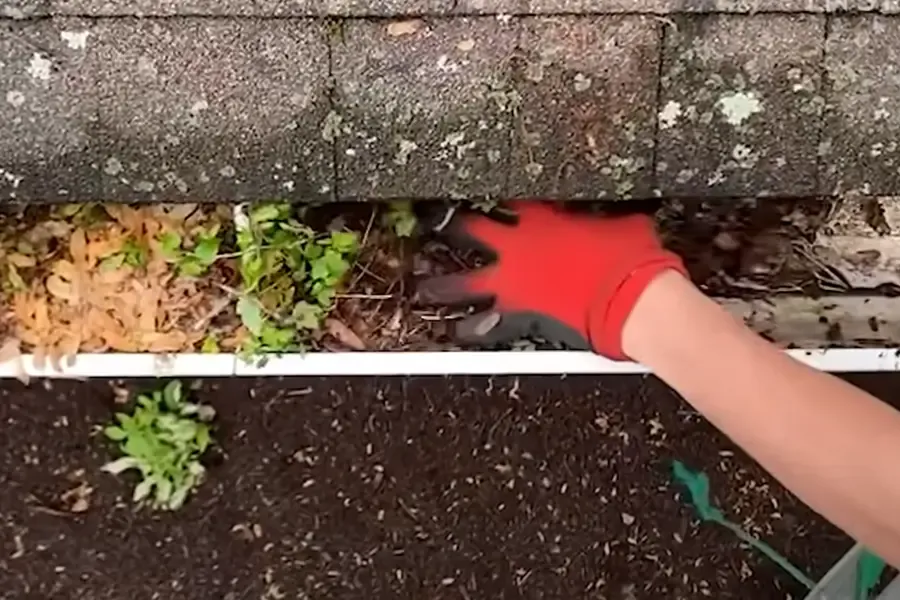
Old Colorado City sits within the older west-side setting where scrub oak, cottonwood, and other deciduous drop can add broad leaves and fine organic material to gutters. Unlike stiff pine that bridges an opening, wet leaves tend to plaster themselves into corners and over outlet holes. Mixed with grit, they form a dense plug that does not need much depth to interrupt flow.
Rooflines and access can vary property by property, especially where additions, porch roofs, or narrow spaces create separate drainage sections. The important step is to map which edge feeds which downspout. One open discharge does not prove that the shorter run behind a porch or a tucked-away corner is clear.
Follow the Stain, Splash, or Quiet Downspout
Evidence often appears below the roof edge. A vertical splash pattern can mark repeated overflow. A dark line beneath a seam can show where water escapes before reaching the downspout. Soil disturbed near one corner may mean concentrated spill, while a quiet outlet during rain suggests the restriction lies above it.
Observe from shelter during a storm and inspect from the ground afterward. Do not move a ladder into a tight side yard or over uneven surfaces without enough room for a stable setup. If access requires leaning across a porch or stepping from one roof to another, professional cleaning is the safer conversation.
Deciduous Drop Is a Sequence
Broad leaves rarely fall on one convenient day. Wind may clear part of a canopy while sheltered branches hold on, and cottonwood material adds its own fine layer. A check after the main drop is useful, but a second cleaning is not automatic. Look at the channel and outlet first. If runoff has an open route, the gutter does not need work simply because more leaves exist nearby.
Summer hail can restart the cycle by shredding remaining foliage and moving roof grit into the same corners. After such a storm, compare discharge from different downspouts. A change in one route is more informative than a general assumption that every gutter filled.
Keep Cleaning Separate From Repair
Debris removal reveals the system. Once a channel is open, water that remains in one section may show lost pitch. Dripping at a joint may reveal old sealant that has separated under sun and freeze–thaw movement. A loose run may need fastener work. Those conditions belong under gutter repair, not repeated cleaning.
Likewise, replacing a long run is not the first answer to one clogged elbow. A focused diagnosis protects useful existing material and keeps the scope tied to the failure. Installation becomes relevant only when damage or layout issues are too broad for a local correction.
Guards on a Leaf-Heavy Edge
A screen may reduce entry of larger leaves, but fine material and leaf fragments can still gather on top. Inside corners and valleys can send water toward the surface faster than it passes through. Before adding guards, confirm that the gutter is pitched correctly, that outlets can be reached later, and that the roof edge does not already overshoot during hard rain.
For a low and accessible section, occasional cleaning may remain the simpler option. For a taller run with consistent leaf load, a maintainable guard may be worth comparing. Neither choice should be sold as maintenance-free.
Request Service in Old Colorado City
Tell us which roof section is involved, the approximate height, nearby trees, and what the water does. Colorado Springs Gutter Cleaning serves Old Colorado City and the wider El Paso County area. Call (719) 628-7121 for a free quote and a plan grounded in the condition you can actually observe.