Find the Failure Before Choosing the Fix
Gutter repair begins with the place where the drainage path stops behaving as intended. A drip from one joint, a run pulling away from fascia, standing water in a clean channel, and a crushed downspout are different failures. Treating them all with sealant or recommending a complete replacement skips the useful diagnostic step.
Colorado Springs weather adds clues. Wet spring snow puts weight on the roof edge. Sunny melt followed by overnight freezing moves water into seams and around already loose fasteners. Hail can dent exposed metal, while intense sun makes old sealant and some plastic components brittle. None of those mechanisms proves that repair is needed, but each helps explain what to inspect.
Repairable Conditions
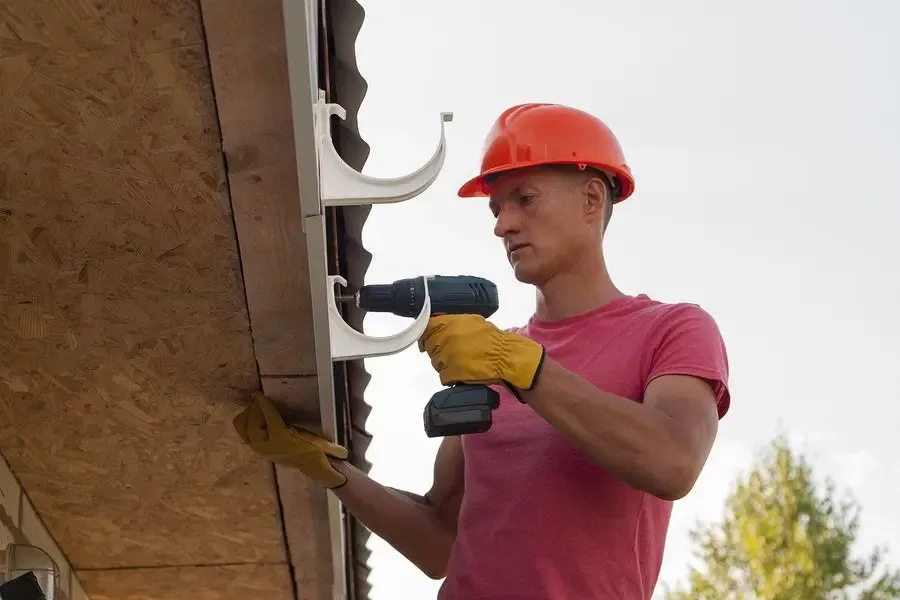
A focused repair may be appropriate for a separated seam, loose hanger or spike, displaced elbow, small leak around an end cap, or a localized pitch problem. The surrounding material must still be sound enough to hold the correction. If corrosion, distortion, or repeated failure extends across long runs, replacement planning may be the more coherent option.
Cleaning sometimes comes first. Packed debris can hold water and make a sound joint appear to fail. It can also hide fasteners and outlet openings. Clearing the channel allows the system itself to be assessed rather than diagnosing the debris layer.
What to Observe From the Ground
Watch safely during rainfall if you can remain under cover. Note the exact start of a drip or spill. Does water come through a seam, pass behind the gutter, jump over the front edge, or pool at one end? After the storm, look for a low section, a gap at the fascia, a disconnected elbow, or erosion below the discharge point.
Do not climb during rain, wind, or an approaching storm. After hail, stay off roofing that may be compromised. Ground-level photos from more than one angle are safer and often more informative than a close picture taken from an unstable ladder.
Repair or Replace?
Repair makes sense when the problem is limited and the remaining system still provides a usable path. Replacement deserves discussion when failures repeat across the same run, the layout lacks practical outlets, or extensive deformation prevents consistent pitch. Cost, disruption, and future maintenance access should be weighed alongside the visible damage.
A dent alone may be cosmetic if water still moves. Likewise, an older system is not automatically a failed one. The decision should follow function and material condition, not age claims or pressure.
Request a Repair Quote
Describe the symptom, the height, and the last storm or freeze event you noticed. Mention whether the gutter was recently cleaned. Call (719) 628-7121 for a free quote and a practical next step.